A competition platform for my gaming group, live at reckreation.com: Elo, proximity matchmaking, seasons, bracket playoffs. Replaces Challonge.
The match log and the org/roster tables are the only authoritative stores; every number the group looks at (Elo, character Elo, standings) is derived by folding the log. Dotted arrows are the v1 work still to come.The list of matches, plus who's in the group, are the only things saved directly. Everything else (ratings, standings) is worked out from the match list. Dotted lines are the parts not built yet.
How to use it
It is live at reckreation.com, and it holds a real group’s record rather than a demo.
The site is live, and what is on it is a real group’s results, not a demo.
1Open reckreation.com on a phoneProduction is its own domain and its own database, redeploying itself when a change lands on main.The site has its own address and database, and updates itself when something changes.
2Join through the group’s invite linkAn organizer copies it off the roster in one tap. Signing in binds you to the participant already holding your rating.Someone in the group sends a link. Signing in connects you to the record you already have.
3Record a set at the tablePick the pair (a recent one is a single button), enter the games, and a bar names what moved.Pick the two players, enter the games, and it says who won and which ratings changed.
4Or hand the link to somebody with no accountStandings, profiles, results and games render signed-out once the group opts in. Private is the default.Standings can be read without an account, but only if the group turns that on.
Every page tells search engines to stay out: real names, slow to undo.
Every page asks search engines not to list it, real names are on them.
What it will do
DeliveredM1: Sign in and see the orgAnyone in the group can create an account and land in the org; the member roster renders; two organizers hold admin.Anyone in the group can sign up on their phone, land in the org and see who else is in it.
DeliveredM2: Record matches and watch Elo moveAny member logs a set; player Elo and per-character Elo update live; standings and profiles render; an edit replays derived history.Anyone can record a match. Ratings and standings update straight away, and correcting a mistake recalculates everything.
DeliveredM3: Run a games nightAn admin creates a season and a session, picks attendees, generates proximity matches with preview and warnings, and runs the night start to finish.An organizer can set up a games night, generate the matches and run the whole evening from the app.
DeliveredM4: Share itAnyone with the link and no account reads standings, recent results, the current session, the player directory and profiles. Noindex, and every write stays auth-guarded server-side.You can send someone the link and they can read the standings without making an account.
DeliveredM5: PlayoffsAn admin spawns a double-elim playoff from a season without concluding it: Elo seeding with drag override, top-seed byes, and a true grand-final bracket reset.An organizer can run a knockout tournament off the back of a season, seeded by rating.
DeliveredM6: History arrivesThe Challonge archive is imported with provenance and Elo is re-derived from date-ordered real history, so the dashboard shows the true all-time record.Years of past results are imported, so the all-time records are real rather than starting from today.
DeliveredM7: Simulate and predictAdmins run sandbox simulations invisible to real views; the group sees Monte Carlo title odds and projected placements on season and playoff pages.The site can predict who is likely to win, and organizers can test a format without it counting.
DeliveredM8: Design competitions on canvasAdmins design competition structures on a canvas that edits the same typed node-graph documents the v1 forms write.Organizers can draw a tournament format instead of filling in forms.
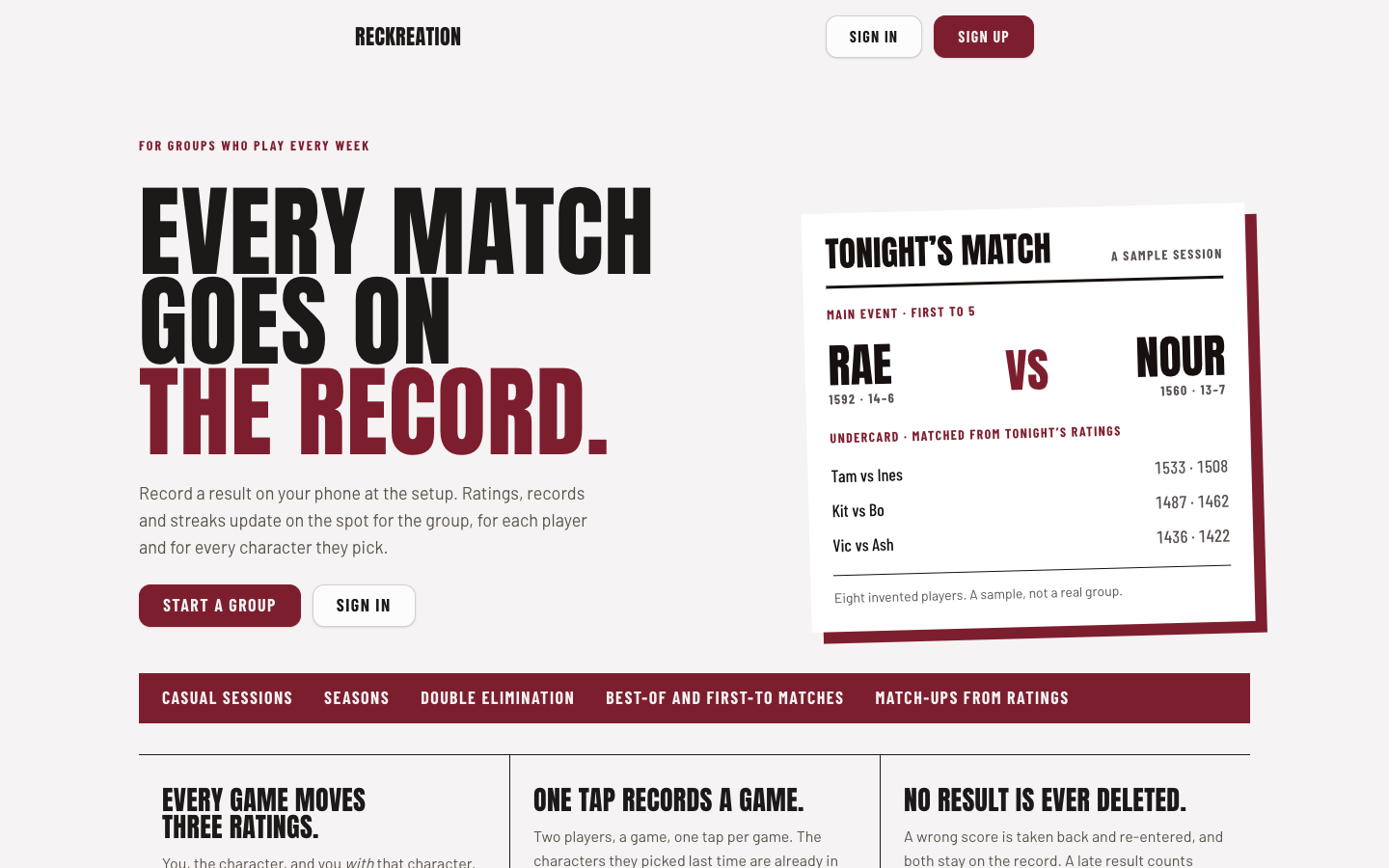
The production site: the front door shows real product screens (a night's board, the entry form, a player's record, a playoff's odds) rather than describing them, and sign-in opens a group's own record.
The real site. Its front page shows four real screens (a night, the entry form, a profile, a playoff) instead of describing them, and signing in takes you to your group.
Feasibility: 4/5
Scored 1–5 on what stands between the idea and a working version: whether the data is reachable through a supported channel, whether anything gates it (approval, cost, another person acting), whether it keeps working unattended, and how much is left to build once the data is in hand.Scored 1 to 5 on what is actually in the way: whether the information can be got hold of properly, whether anyone has to approve it or charge for it, whether it will keep working on its own, and how much work is left once the data is available.
A 4. The record needs nothing external: every result is typed in by the group. Two providers now sit under it: Clerk for sign-in, Render for hosting. Between them they gate the door and the box, never the data. The engine is pinned by 55 tests on a bare checkout. The real dependency is people: a match exists only if a member enters it.
Four out of five. The results themselves need nothing outside the group. Two outside companies are now involved (one handles logins, one runs the site). Neither has a lock on the data, which could be moved anywhere. The core is built and tested. The one real risk is people: it only works if they record their games.
HelpsThe boundary is enforced, not describedThe engine imports nothing outside itself, and a test reads that off the source. The measurable payoff: 55 tests pass in a checkout with nothing installed.The core is kept strictly separate from everything else, and a test checks that rather than a note asking politely. Its 55 tests run on a bare copy.
HelpsReplay makes a wrong number explainableNothing is stored as a current value. The fold takes an ordered log and returns a world state plus every refusal, so a wrong rating can be replayed rather than guessed at.Nothing is saved as a final number. It is rebuilt from the list of things that happened, so you can always see how it got there.
Holds it backEvery result is another person actingNothing arrives on its own: a match exists only if a member types it in at the table. The data source is the group itself, and that is the hardest kind of dependency to schedule.Games only get recorded if someone in the group enters them on the night. The data depends entirely on people bothering.
Holds it backSign-in now depends on an outside serviceClerk handles accounts as of this build. It is free at this scale and only gates sign-in, not the data, but it is the first dependency the group does not control.Signing in now goes through an outside company. It is free for a group this size, but it is the first part of the site nobody in the group controls.
Holds it backHosting moved off hardware I ownProduction is Render rather than a self-hosted server. It buys a real domain and a deploy on push, and it costs a provider.The site runs on a rented service rather than a server I run myself. That gets it a proper address, but it means one more company is involved.
What would raise the score
A night recorded on it, at the venue, by somebody who is not me→ 5/5Being live proves the site runs, not that it is used. The score rises when a whole evening goes in on it and the years of Challonge history sit behind that evening.Being live is not the same as being used. The score goes up when a whole evening gets recorded on it, and the old results are imported behind it.
Elo depends on the order bouts happened in, so a rating edited in place has no derivation behind it. Correcting a result from three weeks ago replays everything after it, which is what makes a years-long org history safe to fix rather than something nobody dares touch. A result it cannot accept is refused by name, never repaired.
Ratings depend on the order games happened in. Because nothing is stored as a running total, fixing a result from weeks ago recalculates everything after it correctly. A result that cannot be right is rejected, never patched up.
Ratings Belong to the Character, Not Just the Player
Three ratings move: yours once per set, the character's and yours-with-that-character once per game (separate K-factors for the player pool and the two character-side pools). It answers the question the group has always asked and Challonge never could: not just who is best, but who is best with what.
Because each character is rated separately, the site can answer who is best with a given character, not just who is best overall.
Recomputed fresh on every reload rather than stored: it draws each unplayed match's winner from the same Elo curve the ratings already use, ten thousand runs seeded by the bracket's own id so two reloads land on identical numbers. A finished bracket names its champion outright and shows no odds at all.
Nothing is saved. Every time you load the page, the site plays the rest of the tournament out ten thousand times using the current ratings, and counts how often each person wins. Once someone actually wins it for real, the odds disappear and the winner's name takes their place.
A scheme is two colors, a background and an accent, and the other twenty-four are derived from them, so seventeen schemes are thirty-four numbers rather than four hundred and forty-two. The logo's own bytes live on the group's row now, resized in the browser first. Only appearance is a group's to change: nothing here moves a rating.
Each scheme is really two colors, a background and a highlight, and everything else is worked out from those two. A group can change how the site looks but not what it means: the green that says a rating went up is the same everywhere, and nobody's rating moves.