Dice Lock Live
A rising-stack dice puzzle. Match faces, reroll at your own risk, bury the other side in locked dice.
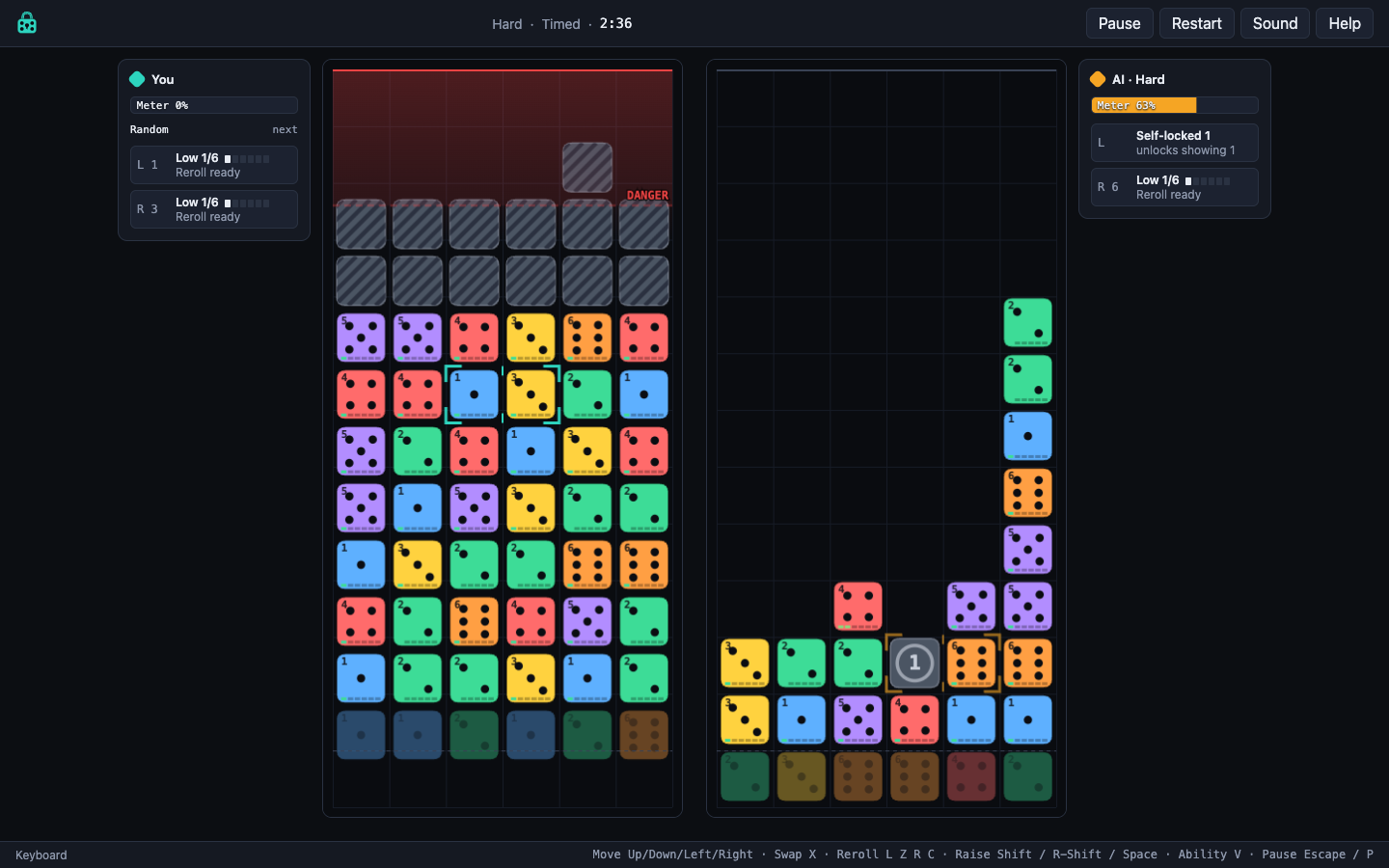
How to use it
Open dicelockgame.com or the iPhone or Android beta, pick a tab from Puzzles to the Tower, and play with keyboard or touch.
Play at dicelockgame.com or in the iPhone or Android test app, pick a tab from the puzzles to the Tower, and play with keys or touch.
- Start a match Battle picks Run the Gauntlet or a friend's room code; Endless picks a speed, Sprint a length; the Tower opens its map. Tutorial has you perform each control.Battle picks the computer or a friend's room code; Endless picks a speed, Sprint a length; the Tower opens its map. Tutorial teaches each control hands-on.
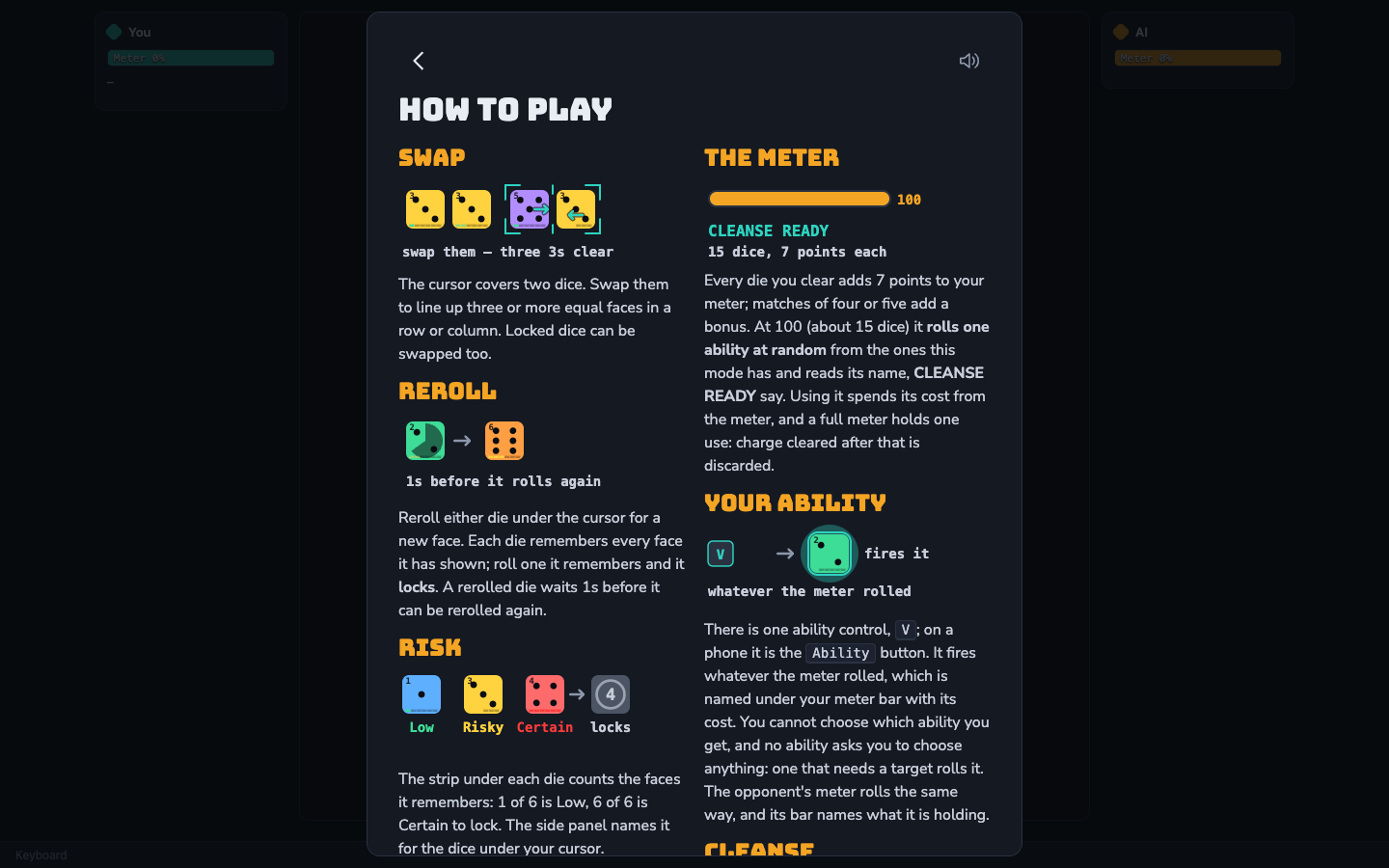
- Match and reroll Arrows move the cursor, X swaps, Z and C reroll dice. Three equal faces clear; a strip shows lock risk.Arrows move the cursor, X swaps the two dice, and Z and C reroll either one. Three matching dice clear.
- Use the meter Clearing dice rolls an ability into one of two cells: free or send locked dice, block a volley, wipe a face, lock theirs, or freeze your rise.Clearing dice rolls an ability into one of two slots: free or send locked dice, block an attack, wipe a face, lock their dice, or stop the rise.
- Tune it STYLE picks your die, world, clear and palette; Settings handles sound and accessibility. The Debug panel pauses the rise and replays a seed.STYLE picks your die, look and color scheme; Settings handles sound and access needs. The Debug panel pauses and replays a seed.
Play Dice Lock
The game, on its own address. Play the computer, a friend, Endless, the Ladder, the puzzles or the Tower.
Play it in your browser at the game's own address: take on the computer or a friend, or play Endless, the Ladder, the puzzles or the Tower.
Test it on iPhone
The iPhone beta, through Apple TestFlight, for iOS 17 or later. The same game as the browser in a native shell, with haptics and the screen kept awake during play; a friend-match link opens the app.
The iPhone test version, through Apple's TestFlight app, for iOS 17 or later. It is the browser game with buzzes you can feel and a screen that stays on, and a friend's match link opens it.
Test it on Android
The Android beta, in two steps on the game's beta page: join the testers' Google group, and opt in on Google Play to install. The same game with haptics, the screen kept awake, and friend-match links opening the app.
The Android test version. The game's beta page has two steps: join the testers' Google group, and sign up on Google Play to install. Same game, with buzzes, a screen that stays on, and friends' match links opening it.
Open dicelockgame.com
The game's own site: a landing page whose hero panel replays a recorded match, a privacy page, an accessibility statement, and a home-screen icon that installs it on a phone.
The game's own website: a front page that plays a real recorded match, pages on what it collects and what it supports for access needs, and adding the game to your phone's home screen.
Reroll Memory
- Player board: grid, cursor, rise, resolution state machine
- Seeded random stream: forked per board and for the AI
- Pure grid rules: matching, gravity, damage, row generation
- Canvas renderer: dice, risk strips, cooldowns, cursor, floating text, queued-die markers
- Status panels: meter, chain, dice under the cursor
The risk is shown, the history is not: the cursor's frame tightens around the die being decided about, on by default. A words panel can say the same risk aloud; switch it on in Settings. A corner numeral and a segmented strip are optional extras too. Deciding whether a reroll is worth it is the whole game.
You are told how risky a reroll is, not which numbers a die has shown, through a highlight around your cursor, on by default. A written readout can tell you the same thing, if you turn it on in settings. A new die rarely locks; a well-worn one almost always does. Choosing when to gamble is the whole game.
Same Rules, Both Boards
- AI controller: decides every interval, walks its cursor, same legality checks
- AI board: identical rules
- Battle: ability meters, attack routing, clock, score, result
- Pure grid rules: matching, gravity, damage, row generation
- Seeded random stream: forked per board and for the AI
- Headless simulator: AI versus AI for balance numbers
Six opponents, Novice to Legend, differ only in decision speed, search depth, accepted lock risk and when abilities fire; the engine is deterministic from a seed, so a match replays exactly. A chain of two or more sends its locked dice as one solid block that buries a stretch of the other board, rather than one at a time.
The six difficulties differ only in how fast the computer thinks, how far ahead it looks and how much risk it takes. The game replays exactly from a seed, which is how it is tested. A chain of two or more locks a solid block of dice into your board instead of scattering them one at a time.
Endless
- Player board: grid, cursor, rise, resolution state machine
- Main loop: fixed 60 Hz steps, screens, pause
- Battle: ability meters, attack routing, clock, score, result
- All-time boards: the best number a signed-in player has reached per mode, kept for ever, read back as a ranked board
- Paused games: one slot per mode, kept in the browser until its own ending rather than a time limit
Pick a speed. Zen never speeds up: the easy way in. Cruise ramps and settles, so a run lasts as long as you do. Surge never stops rising, so every run ends in a top-out. Cruise and Surge rank signed-in players all-time; a paused run waits in the browser. Sprint puts this board on a clock: Heat, Burn or Blaze.
Pick a speed. Zen never gets faster: the easy way in. Cruise speeds up and levels off, so a run lasts as long as you do. Surge speeds up until it buries you. Cruise and Surge rank signed-in players all-time, and a paused run waits in your browser. Sprint puts this board on a clock: Heat, Burn or Blaze.
Puzzles and the Tower
- Player board: grid, cursor, rise, resolution state machine
- Pure grid rules: matching, gravity, damage, row generation
- Browser settings: sound, reduced motion, difficulty, pace
- Main loop: fixed 60 Hz steps, screens, pause
- Status panels: meter, chain, dice under the cursor
- The Ladder: an endless run of puzzles whose difficulty tracks one rating that moves after every puzzle, hard boards dealt from a season's own store on the server and checked there, easy ones built and solved on the device
- Battle: ability meters, attack routing, clock, score, result
- AI controller: decides every interval, walks its cursor, same legality checks
- Synced Tower climb: which floors and steps are cleared, the best score and stars for each, the fastest clear time once a step has one, and the best failed try per step, kept once per player, only ever added to except by a Restart the Tower, which clears the steps, Guardians and failed tries and keeps the crowned floor
A world opens at seven of the previous ten solved or shown, and a shared link opens any puzzle. The Ladder's difficulty tracks a hidden rating. The Tower stacks twenty-five floors of seven boards: most race a target score solo, while the mid-boss and Guardian duel the Battle AI. Each floor adds one new ability, and progress syncs across devices.
A new set opens once you finish most of the one before; a friend's link opens any puzzle. The Ladder gets harder as you improve. The Tower has twenty-five floors of seven levels: most are a solo race to a score, and two bosses play like the computer. Each floor teaches one new power, and signing in carries progress everywhere.