Chess Coach Deprecated

Finds the recurring habit behind why I lose at chess, not just the losing move.

Deprecated. No longer maintained or developed. The code and its tests stay as they are.I'm not working on it anymore. The code stays as it is, and nothing new is coming.
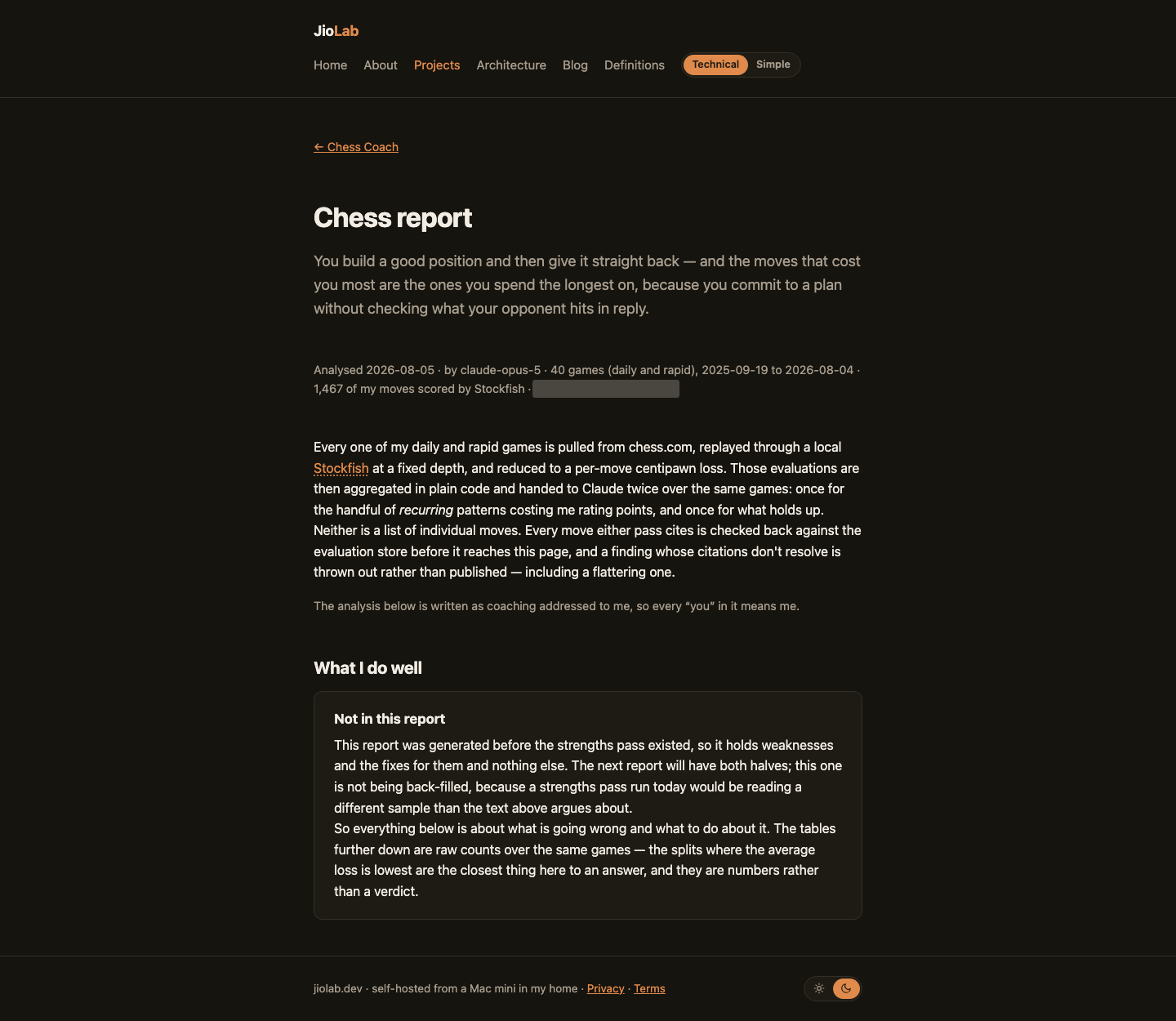
The published report page: the headline pattern, the sample it was computed over, and the per-pattern sections with the moves cited underneath each.
The report page on this site, showing the main habit it found, how many games it looked at, and the moves that prove each point.
(1/3) Big Brain chess digest Last 7 days: 1 game 2026-08-04 loss as black vs nicjosephs (1198), resigned Sicilian Defense Smith Morra Gambit Patterns over 40 evaluated games (2025-09-19 to 2026-08-04, 1467 scored moves): You build a good position and then give it straight back, and the moves that cost you most are the ones you spend the longest on, because you commit to a plan without checking what your opponent hits in reply. 1. Your longest thinks are your worst moves (high confidence) When you stop and think hard, you tend to talk yourself into a committal move (a capture, a sacrifice, a pawn push) and play it without a final check of the opponent's replies. Moves you play instantly are statistically safer than moves you agonise over. when: Middlegame positions where you sense a chance or a problem and burn far more time than your own average for that game; both colours, both winning and worse positions. evidence: Moves classed "long" relative to your own pace: 532 moves, 16 blunders / 26 mistakes / 94 inaccuracies, avg 45.3cp. "Snap" moves: 377 moves, only 7b/11m, avg 32.2cp. Nearly every catastrophic swing in the sample is a long think: G21 ply 27 Bg5 (-808cp, 2.0x pace), G26 ply 84 Rc2+ (-731cp, 17x pace), G26 ply 56 Qxf3 (-612cp, 15x pace), G17 ply 78 Rg4 (-533cp, 4.3x), G19 ply 33 Nd4 (-361cp, 7.1x), G39 ply 39 Rd5 (-307cp, 4.6x), G8 ply 49 Nxd7 (-293cp, 94x), G2 ply 63 bxa4 (-207cp, 21x). work on: Make the last 15 seconds of every long think a fixed ritual: name the move you intend, then list every check, capture and threat your opponent has in reply to it. If you cannot find a defence to one of them, pick a different move. Specifically distrust captures and pawn pushes you found late in a long think. e.g. 2026-01-02 move 14 Bg5 (-808cp blunder) e.g. 2025-11-28 move 42 Rc2+ (-731cp blunder) 2. Winning as White by move 15, then no follow-through (high confidence) With your d4/London-Zukertort setup you reliably reach a clear advantage in the first 15 moves, but you don't have a way to finish. The thematic breakthrough (Bxh7+, Nxf7) goes unplayed, you make another quiet rook or knife move instead, and the advantage reverses. when: White, Queen's Pawn/Zukertort/London structures, around moves 12-30, once your pieces are aimed at the kingside (typically Bd3 + Ne5). evidence: Three full losses from a winning position: G2 (+3.2 at move 12, lost), G19 (+2.2 at move 16, lost), G25 (+2.9 at move 12, lost). In these structures the engine repeatedly wanted the same shot and you played something else: Bxh7 in G2 ply 25, G6 ply 43, G6 ply 55, G25 ply 25; Nxf7 in G4 ply 19 (-497cp), G15 ply 21, G31 ply 23. Zukertort/Chigorin lines account for 597 scored moves at 35.5-35.9cp average, with the damage concentrated in moves 21-30 (avg 45.1cp across the sample). work on: Spend one session learning the two standard tactics of your own setup: the Bxh7+ Greek gift with Ne5/Qh5 support, and Nxf7 when the f7 knight is loaded. Every time you have Bd3 and Ne5 pointing at a castled king, calculate Bxh7+ and Nxf7 first, before you consider a rook move. e.g. 2026-07-11 move 10 O-O (-497cp blunder) e.g. 2026-07-25 move 13 Ng4 (-207cp mistake)
The first of the three messages a weekly digest arrives as: the games since the last one, the headline pattern, then each pattern with when it fires, its evidence and what to work on.The weekly message it sends me (the first part of it): what I played, the main habit it found, and what to practise.
Architecture diagram: Chess Coach monthly game files centipawn loss perhalf-move citations verified chess.com archives Archive pull Raw archives Import and normalise Game and evaluation store Local engine evaluation Evidence pack Pattern synthesis Stored reports Weekly digest Telegram Report snapshot Published report page Question in chat Scoped answer
Pull every game, score every half-move locally, aggregate before reading, and publish nothing a real move cannot back.It downloads every game, checks every move on my own computer, adds it all up, and only says what it can point at a real move to prove.

How to use it

Three ways in, and one thing worth knowing about the answers.

Three ways to use it, and one thing worth knowing about what it tells you.

  1. Wait for the weekly digest Arrives only if the games changed. A quiet week stays quiet.It messages me weekly, but only if I have actually played.
  2. Ask about specific games, any time A question in chat runs the same analysis over whichever games it names.I can ask about particular games whenever I want.
  3. Expect a different answer for one game than for several One game gets a mistake; a set gets a habit. Both are true and they are not the same question.Ask about one game and it names a mistake. Ask about many and it names a habit.
  4. Or just read the published report The current findings, with the moves behind each, on this site.The latest findings are on this site, with the moves that prove them.

Read the current report

The live output: the habits costing me rating across the scored games, the moves behind each, and what to practise. Weaknesses only so far, and the page says so.

The live result: the habits losing me games, the exact moves that show each one, and what to work on. It only covers what is going wrong, and admits that.

Built From a Username

The archive pull, the local database, installing the engine, scoring every game and publishing the report were all built and run without further input. Fetching is conditional and merges rather than appends, so a second run over unchanged months rewrites nothing at all. The one thing it could not do was decide what was worth measuring.

From just a username, it downloaded the games, set up a chess engine, went through every move and published a report, all without being told how. Running it again when nothing has changed does nothing at all, which is why it can sit on a timer.

Every Move Scored at Home

Nothing is sent anywhere to be scored: the engine runs locally, bounded so a run cannot take the machine, and it resumes at the exact half-move it was stopped at. The output is the gap between the best move and mine, per position: the raw material for a pattern rather than a verdict on one game.

The analysis happens on my own machine, and it picks up exactly where it left off if it gets interrupted. For each position it records the difference between the best move and the one I played, which is what makes a pattern visible.

Patterns, With the Receipts Checked

Aggregating before reading is what makes the answer a habit rather than an anecdote: the model is handed a table, never the games. Every finding has to cite specific scored moves; a citation that cannot be resolved is discarded, and a finding whose citations all fail is rejected rather than published unsupported.

It groups everything first, so what comes out is a habit rather than one bad game. Anything it says has to point at real moves, and if it cannot, that finding is thrown away rather than published.

Weekly, On Demand, and Published

A quiet week produces no message rather than a re-run of the same report, which is what keeps the weekly note worth opening. The same analysis answers a question typed in chat, scoped to whichever games were mentioned, and the current findings are published as a page with the moves behind each one.

If I have not played, it stays quiet instead of repeating itself. I can also ask it about specific games whenever I want, and the latest findings are on this site for anyone to read.